

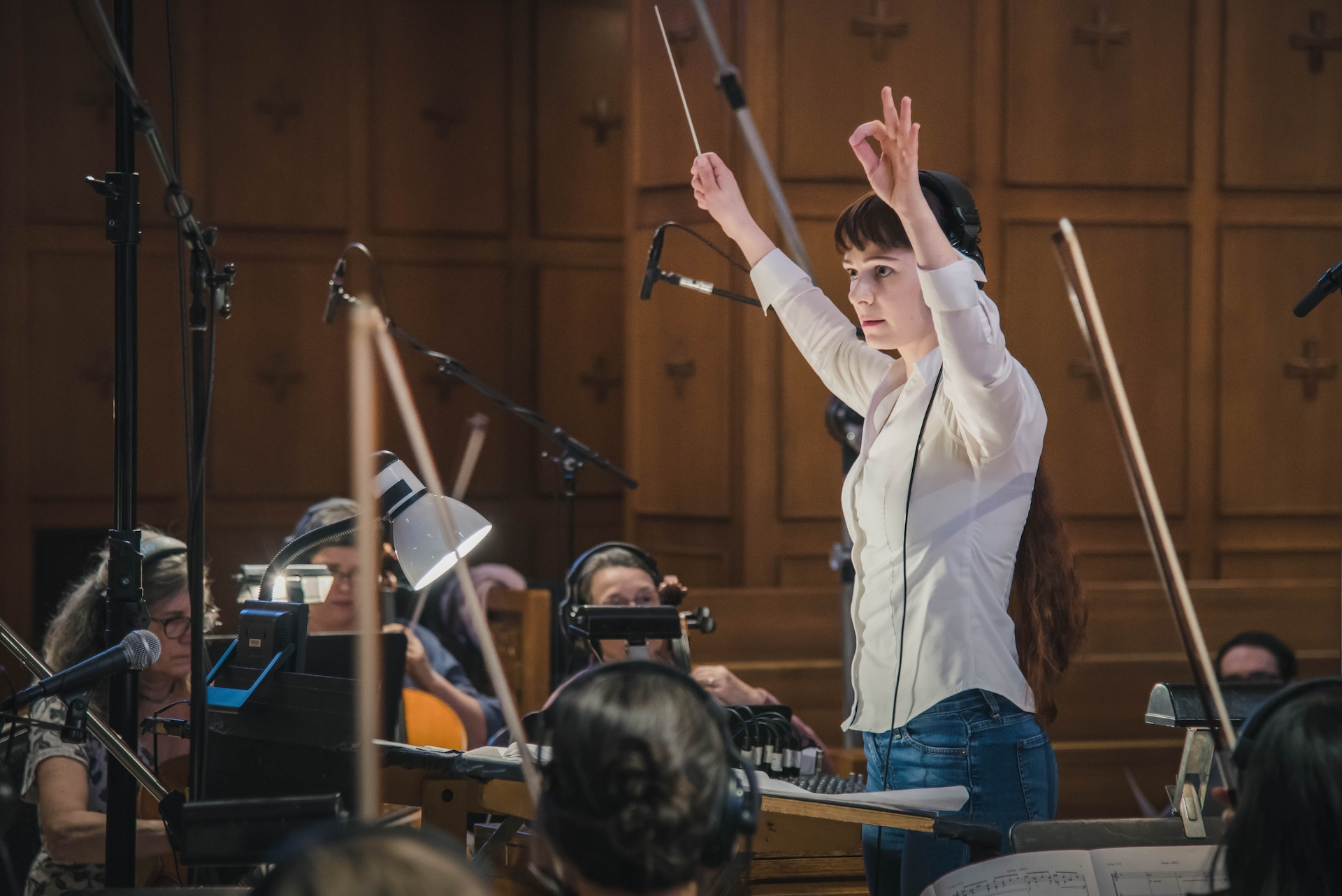
Grace was our composer for the film who created the original score and the ending theme song. How I was introduced to her was by chance, but destined, I felt. Toward the end of the last shooting day, I casually asked one of the actors, Bonne-Vejou Dorrell, if he knew any composer who might be able to work with me in post-production. He said he could only think of one person, that was Grace. So I contacted her.
It turned out that Grace had long-time interest and passion in Japanese culture and language, and desire to learn the Japanese martial art, kendo, some day. She kindly accepted to work with my film. Collaborating with Grace for the music making process was one of my favorite experiences in the post-production phase.
When I think of her, I think of this Japanese concept, 一期一会, ichigo ichie, literally means “one time, one meeting.” It is often quoted in tea ceremony settings and also martial arts practice. The deeper teaching of this concept is to cherish every moment because the moment will never come again, so be fully engaged in whatever you do in that moment.
So, here’s Grace.
Yuriko: What was your first thought/reaction when I asked you to make music for SPIRIT MOVES?
Grace: Japanese films have long been a source of inspiration for me. At their best, they are painstakingly crafted, with incredible attention to detail and ties to respect for nature and ancestral past. Although I am from a Western culture, I have always felt a deep connection to these themes, and so Japanese films fulfill the desire to see them manifest. This is the first time I’ve been asked to participate in a film with Japanese cultural ties, and I immediately wanted to contribute from my own spirit music that reflects those values.
Yuriko: What is your connection with Japan and its culture and language?
Grace: I’ve studied the Japanese language since junior high school, and my best friend’s family were connected with the Japanese foreign exchange students at the local college. Thus, I had the fortune to be exposed to the culture, albeit second-hand, from a young age.
Since then, I’ve lived in Japan twice, once in Nagano-ken, once in Wakayama-ken. I love the countryside most of all. I miss the little shrines that deify nature spirits, the bricks that line the narrow roads, the clear river water and the rice paddies, and of course the food! Japan has many irreplaceable cultural experiences.
Yuriko: Is there any scene that personally inspires you in the film? Can you give us a little teaser?
Grace: For me, the most inspirational scene is when Sailor reconnects with her kendo equipment and finds the photos of her ancestors. Up to that point, I hadn’t used the taiko drums, but I knew they were coming up for the next scene. I felt like it was appropriate to introduce them at this point, and the depth of the drums connects Sailor to her great-grandfather’s past.
Yuriko: In the process, what did you enjoy the most? Did you have any creative challenges?
Grace: When I’m composing, it’s very instinctual. I get lost in the creative process and can’t really remember any of it afterwards. I just look back at what was written and can’t believe I had a part in writing it. So the most enjoyable part is simply hearing the music in the finished film.
Working on the J-Pop song at the end was probably the most challenging. J-Pop has a very unique sound, and I wanted to make my own song reflect some of that uniqueness. So I ended up studying a lot of J-Pop music to find out what made that sound so distinctive, and then tried to write it naturally in my own style.
Yuriko: What was your creative process of writing the music and lyrics of “Fearless Sailor”?
Grace: I had a trip to Hawaii planned already when I received the assignment, so I started studying Hawaiian music on the trip. I also had the fortune to be seated next to an elderly Japanese-American man on the flight over to the Big Island who was born in Hilo. He and his wife gave me an insider’s tour of the area when we landed, and they showed me where the sugar cane fields and Japanese camps and the school had been. I was absorbing all of these experiences and trying to figure out what Sailor’s childhood had felt like, as well as those of her ancestors. But the song was still reluctant to come.
At last, one morning I headed over to a local café with amazing coffee, and asked again, “What is important to Sailor?” I looked out at the ships in the harbor and felt the wind, heard the snap of the sails, and thought “Sailor is on a journey.” I felt that evoking the experience of sailing itself would give the listener a strong connection to Sailor’s feelings. The song came easy as wind and was finished in about 30 minutes.
I didn’t feel comfortable writing the Japanese lyrics myself, so it was a relief to have Aska-san translate the words and work with me to make them suit the song. *
Yuriko: Lastly, what would you like to say to the future audience about this film?
Grace: What I love about the Japanese films I cherish is the 間 that can be felt in each scene. The space, the quality of emptiness, that assumes a certain emotional intelligence in the viewer. So while you are watching “Spirit Moves”, I hope you will listen for the words that are unspoken, and look for details that tell you about Sailor and what is important to her. Absorb the feelings and the motives, let your mind accept the bigger story.
*Aska Iijima, Japanese Language Instructor, Kendo Scene Coordinator, Wardrobe
Grace Wallis is the composer for award-winning Pacific Northwest independent films, including Paranormal Investigators, Once Upon a Time in the Wasteland, Big Trouble in Seattle, Blade of Vengeance and Spirit Moves: Me and Gee Gee Willie.  Having the privilege to win awards for Best Score on multiple occasions, it is her pleasure to continue to work in the vivid, imaginative space that is the Pacific Northwest filmmaking scene.
With a wide variety of genres from fantasy-action to social justice commentary, Wallis makes use of both orchestra and synthesizers to bring visions to life.  Recording on her 1948 Baldwin grand piano adds an intimate touch to some of her scores.
https://www.gracewallisstudio.com/
The ending theme song for SPIRIT MOVES, “Fearless Sailor” by Grace Wallis.